
Metal Roofing Services · Conroe, TX
Storm Damage Metal Roof Repair in Conroe, TX
After hail or high winds, the useful question is not whether a metal roof looks damaged but whether anything has stopped doing its job. Those are different things, and telling them apart is what a storm evaluation is for.
- Wind, hail & rain damage
- Appearance vs function
- Clear repair options
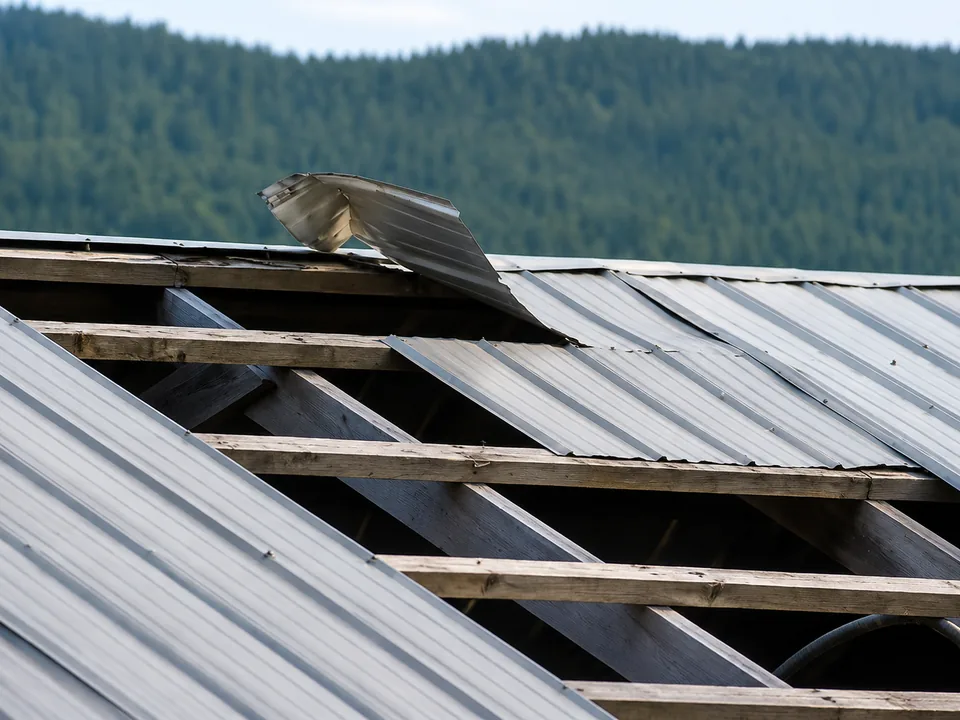 Storm damage roof check
We look at what moved, not just what looks marked.
Metal handles weather well, which is part of why it gets misjudged afterwards. A roof can be visibly marked and still be sound. It can also look untouched from the driveway while a lifted panel edge or shifted flashing quietly lets water in.
One thing worth saying first: stay off the roof. Wet metal is slick, storm-loosened panels move underfoot, and a roof that has just taken a beating is the worst place to go looking for damage. A ground-level check can reveal some obvious damage safely, but hidden, interior or attachment-related conditions may require a closer professional inspection.
The Service
What Storms Actually Do to a Metal Roof
Wind damage can concentrate at edges, corners, ridges and other high-uplift details, but the actual pattern depends on the roof system, attachment and the event. Where uplift concentrates — eaves, rakes, ridges and corners — panels lift and reseat, trim loosens, and ridge closures shift. A panel that lifted and dropped back can look entirely normal from below while its fixings have been stretched.
Hail does something different. It arrives as impact on a surface built to shed water, not absorb blows, and much of what it leaves is denting. Denting matters when it has fractured the coating through to bare metal, or when the force was enough to disturb a seam, loosen a fastener, or knock a flashing out of position. On its own, a dent is a mark.
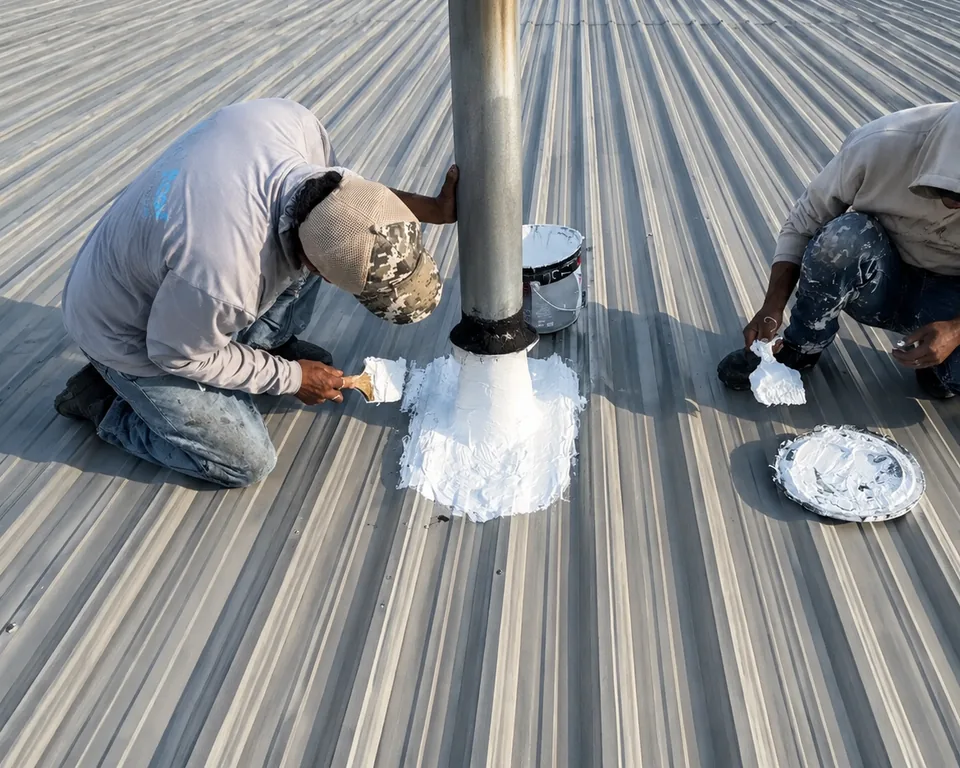
Wind-driven rain is the quiet one. It does not need damage to get in, only a gap, and storms produce gaps by moving things very slightly. A flashing that shifted a quarter of an inch is invisible from the ground and perfectly capable of letting water past.
 Storm damage roof check
When To Act
What You Can Safely Check Afterwards
What you can check yourself is limited to what is visible from the ground, and that is enough to decide whether a closer look is worth arranging. Worth noting, and photographing if you can:
- A panel edge or corner that has lifted, or trim that has come away.
- Panels that look misaligned, or a seam line that no longer runs straight.
- Fastener heads standing proud, or screws on the ground near the building.
- Dents across panels, or on gutters, downpipes and flashing.
- Bright metal showing where coating has been scraped or chipped.
- Debris resting on the roof, caught in a valley, or blocking a gutter.
- A new water mark on a ceiling or wall, or damp insulation in the attic.
- Ridge or edge trim that has shifted or gone missing.
Conditions
What to Look For, and What It May Mean
These are common storm-related conditions found on metal roofs, not descriptions of specific projects completed by Conroe Metal Roof Pros. None of them is a diagnosis on its own, which is why a closer look is worth arranging.
How a roof responds depends partly on the system it uses.
Exposed-fastener panels are held by screws through the panel face, so wind works directly on those fixings. The common findings afterwards are backed-out screws, split or flattened washers, and slightly enlarged holes. Those are usually repairable, and the easiest thing to miss from the ground.
A standing seam roof hides its fixings and lets panels move on clips. That generally handles wind well, but uplift still concentrates at edges and ends, and a clip that has been overworked can leave a panel loose along a run with nothing obvious to see. Seam engagement and clip behavior are what get checked.
| Condition noticed | What it may indicate | Why evaluation matters |
|---|---|---|
| Lifted panel edge or corner | Uplift has worked the panel and may have stretched or loosened its fixings | A panel that lifted and reseated can look normal while its hold has been reduced. |
| Open or separated seam | Movement during the storm, or a fixing that has stopped holding | Seams keep water out by shape, so an opened one can leak without looking damaged. |
| Loose or missing fastener | Wind working the panel, or an impact close to the fixing | Each one is a potential opening, and neighbouring fixings then carry extra load. |
| Damaged or shifted flashing | Wind or debris moving a detail that was directing water outward | Small movement at flashing is among the most common causes of a post-storm leak. |
| Surface denting | Hail or debris impact | Denting alone does not prove a loss of function. What matters is the coating, the seams, and the details around it. |
| Exposed or scratched coating | Impact or debris cutting through the finish to bare metal | Where coating is breached, corrosion starts at that point rather than across the panel. |
| Interior water mark | Water has found a path, though not necessarily above the stain | The entry point usually sits elsewhere, so the mark is a starting point rather than a location. |
| Debris near a valley or drain | Storm debris blocking the route water needs to take | Water backing up at a valley or drain can get under panels that are otherwise sound. |
Water Entry
When a Leak Appears After a Storm
A leak after a storm is not evidence that the roof needs replacing. Most come from one detail that moved: a flashing, a penetration, a seam, or a run of fasteners. Put the detail right and the leak stops.
Where water appears inside is rarely where it got in, because it runs along panel undersides and framing first. The source is found by working back from the stain and checking each plausible entry point above it.
It is also worth ruling out condensation, which can look like a leak and can appear after the same weather that caused a real one. Damp insulation with no route to the outside usually points that way instead. General metal roof repair covers the non-storm version of all of this.
One thing not to do, whoever does the work: running sealant over every visible mark is not a diagnosis. It hides the symptom, holds water against the panel, and makes the source harder to find later.
The Decision
Repair, Monitor, or Replace
Storm damage may be repairable when it is localized; widespread displacement or system-level damage may require a broader repair or replacement evaluation. Damage often concentrates where the weather concentrated, at edges, corners, ridges, and wherever the wind or debris happened to land.
Monitoring is a legitimate answer too. Some conditions are worth recording and revisiting rather than acting on immediately, particularly cosmetic denting on a roof that is otherwise performing.
Replacement enters the conversation when damage is spread across the roof rather than concentrated, when panels have been displaced over a wide area, or when an older roof has been pushed past the point where repairs make sense. Replacement covers that work, and the metal roof cost guide covers what drives the numbers.
What decides it is the extent, the panel system, and the surrounding roof condition, not how bad the worst spot looks.
How It Works
Our Process
- Step 1
Review what happened
What the weather did, when you first noticed something, and what you have seen since. Ground-level photographs help if you have them.
- Step 2
Examine the affected areas
The areas you reported, plus the edges, ridges, penetrations and transitions where storm forces concentrate.
- Step 3
Separate appearance from function
Which marks are cosmetic, and which conditions have actually affected how the roof sheds water.
- Step 4
Explain the options
What a repair would involve, what is worth monitoring instead, and whether a wider conversation about the roof is warranted.
- Step 5
Confirm the agreed next step
Approved work carried out and reviewed afterwards. No predictions are made about what an insurer will or will not do.
Next Steps
After the Evaluation
You get a description of the visible conditions found, what they appear to relate to, and the practical options. Work that is needed gets quoted so you can decide. Where monitoring is the sensible route, that gets said plainly rather than dressed up as urgency.
One boundary worth being clear about: a roof evaluation can clarify visible conditions and practical repair options, but it does not determine insurance coverage or claim outcomes. Those are decided by your policy and your insurer, and your own documents are the right place to start there.
Property Type
Homes and Commercial Buildings
On houses, the practical limits are access and pitch. Steep or fragile roofs are assessed from the safest available position rather than by walking every plane, and what can be examined directly shapes what can be said with confidence.
On commercial buildings, storms tend to find the penetrations. Rooftop units, curbs, vents and conduit all stand proud of the roof plane and take wind loading directly, and low-slope sections add drainage to the list as soon as debris arrives. Commercial metal roofing covers that side of the work.
Scope
What Affects Storm Damage Work
No flat price is published here, because storm damage varies with what the weather actually did. What changes the scope:
For a full breakdown, see our metal roof cost guide for Conroe, TX, then request a metal roof estimate.
- How much of the roof is affected, and whether damage is concentrated or spread.
- Which details moved: flashing, fasteners, seams, panels, or trim.
- Panel system, since exposed-fastener and standing seam work differ.
- Whether water has already reached the deck or interior.
- Roof access, pitch, and safe working conditions after the storm.
Storm damage on a metal roof?
Tell Conroe Metal Roof Pros what the weather did and we will help you work out the next step.
Keep Exploring
Related Metal Roofing Services
Explore the services that pair with this one, or see the full list.
Service Areas
Conroe Metal Roof Pros serves Conroe and nearby Montgomery County areas.
Answers
FAQs About Storm Damage Roof Repair
Can storm damage to a metal roof usually be repaired?
Usually, yes. Storm damage tends to concentrate at edges, ridges, corners and penetrations rather than spreading evenly, so the rest of the roof is often sound. Replacement becomes the discussion when panels have been displaced over a wide area, or an older roof pushed past the point where repairs make sense.
Can wind damage a standing seam metal roof?
It can. Concealed fixings handle wind well, but uplift concentrates at edges and panel ends, and a clip that has been overworked can leave a panel loose along a run without much to see from below. Seam engagement and clip behavior are the things worth checking after a significant blow.
Why might storm damage not be visible from the ground?
Because the conditions that let water in are small: a backed-out screw, a flashing that shifted a fraction of an inch, a seam that opened at one end. None of that reads as damage from the driveway, and a roof with no obvious dents can still have taken something worth putting right.
How soon after a storm should the roof be looked at?
Before the next significant rain, if you can manage it, since a small opening left through another downpour is how a contained problem reaches the deck and interior. Not every visible mark needs immediate attention, but active water entry, loose or displaced metal, debris sitting on the roof, or a visible opening at a seam or flashing are all worth having evaluated promptly. Either way, do not climb onto wet or storm-damaged roofing to look.
Can I go up and check the roof myself after a storm?
Please do not. Wet metal is slick even on a shallow pitch, and panels loosened by wind can move under your weight without warning. Anything useful at this stage is visible from the ground, and photographs from there are more helpful than a closer look that puts you on the roof.
Does a roof evaluation determine whether insurance will cover the damage?
No. An evaluation can clarify the visible condition of the roof and the practical repair options, but it does not determine insurance coverage or claim outcomes. Those are decided by your policy and your insurer.