
Metal Roofing Services · Conroe, TX
Metal Roof Inspection in Conroe, TX
A metal roof inspection tells you what condition your roof is really in: what is sound, what needs attention soon, and what can wait. Metal-roof problems often develop at details such as seams, fasteners, flashings and penetrations, but failure patterns vary by system and event. An inspection can identify visible or accessible conditions before they develop further, although hidden conditions cannot always be confirmed without additional access.
- Whole-roof condition check
- Clear, honest findings
- Post-storm assessments
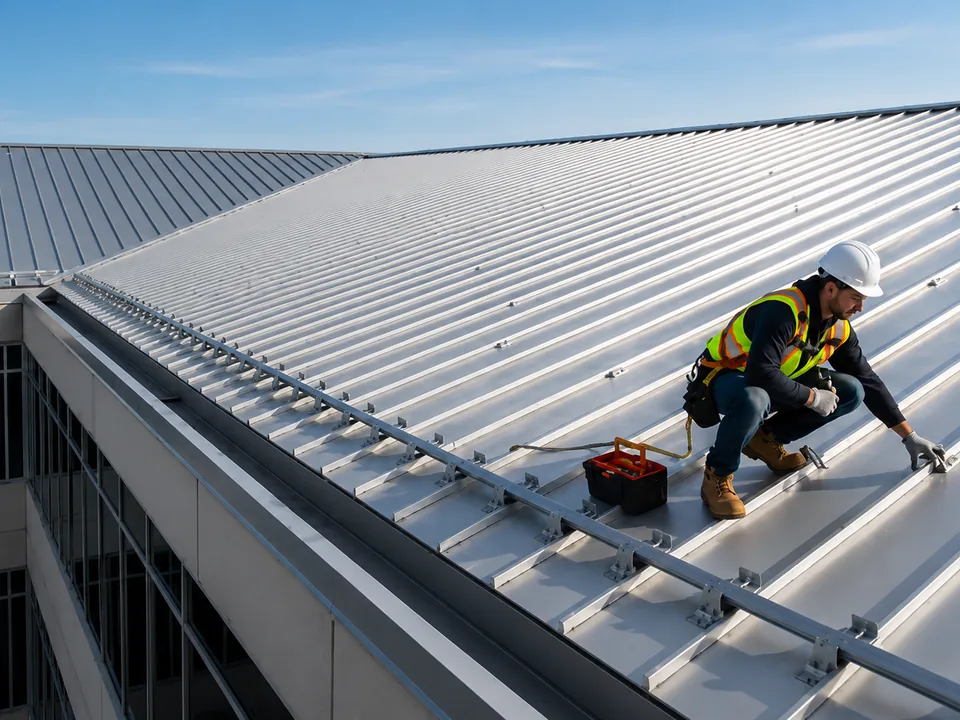 Metal roof inspection
An inspection gives you a clear picture before you decide.
Much of what shortens a metal roof’s life is small. Sealant hardens at a pipe boot. A washer flattens and a screw backs out. Flashing shifts at a wall and starts holding water instead of shedding it. None of that is visible from the driveway, and some early defects may be simpler to address before they contribute to wider damage, though repair cost depends on access, the roof system, materials and project scope.
An inspection is a diagnostic visit. If the roof is in good shape, that is a useful answer too, and it is the one you will get.
The Service
What Makes a Metal Roof Inspection Different
A general roof check looks for missing or broken material. That works on shingles, where failure usually looks like damage. Metal behaves differently. Panels can be completely intact while the roof leaks steadily, because water is getting in at a seam, a fastener, or a flashing joint rather than through the panel itself.
So a useful inspection follows the water instead of scanning for damage. It also reads the effects of movement. Metal expands and contracts with temperature every day, and clips and fastener holes absorb that for years. Evidence of that movement is often the earliest sign that something needs attention.
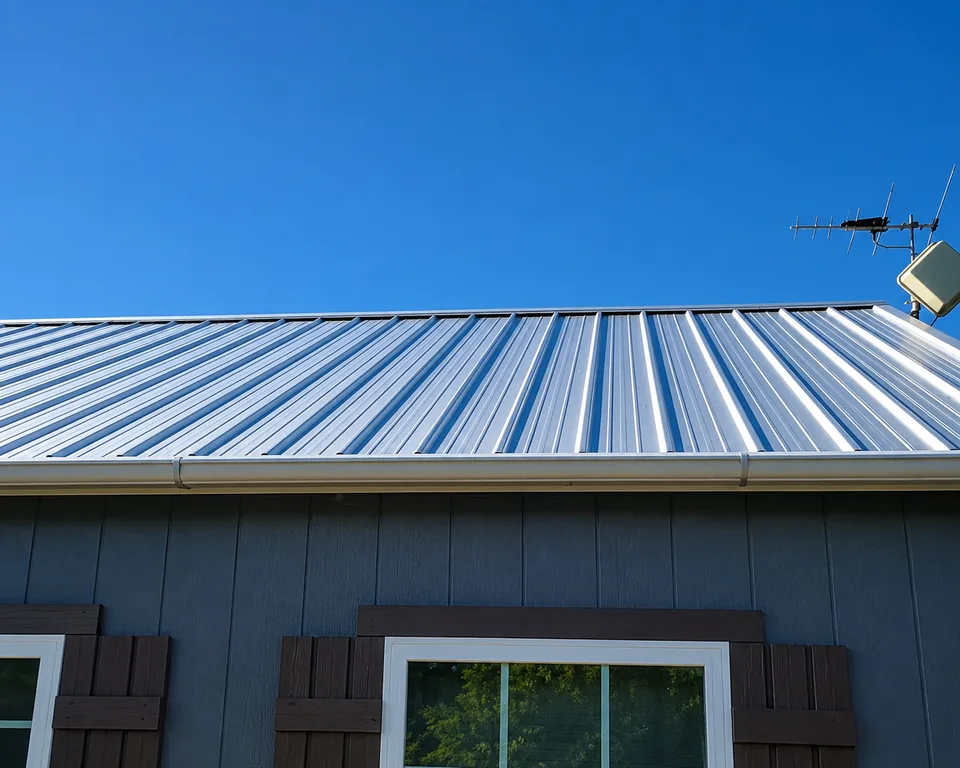 Metal roof inspection
When To Act
When an Inspection Is Worth Booking
There is no need to check a sound roof constantly. These are the moments when a look earns its keep, along with the signs worth acting on:
- After hail or high winds, ideally before the next heavy rain.
- Before buying a property, while you can still act on whatever turns up.
- When a stain, drip, or damp smell appears indoors.
- When fastener heads sit proud of the panel, or a row no longer looks even.
- When rust streaking shows below fasteners, at panel ends, or at cut edges.
- When a panel edge has lifted or trim has worked loose at a corner.
- When sealant at a pipe boot has gone hard, cracked, or pulled away.
- When the roof drums or bangs in wind and did not before, which usually means something has come loose.
- On an older roof, at an interval suited to the roof system, its age, manufacturer guidance and exposure.
The Checklist
What Gets Examined
A metal roof is a system of details, and these are the ones that decide whether it keeps working. What follows describes conditions commonly found on metal roofs, not specific projects completed by Conroe Metal Roof Pros.
How much attention each of those needs depends on the panel system. A standing seam roof hides its fixings and lets panels move against clips as temperatures change. Fewer holes through the panel means fewer built-in leak points, so the focus shifts to whether seams have held, whether panels still move freely, and the condition of flashings and penetrations.
An exposed-fastener roof puts hundreds of screws straight through the panel, each sealed by a rubber washer. Those washers wear out years before the panels do, and faster on sun-exposed slopes. Backed-out screws, flattened washers, and slightly enlarged holes are the normal wear pattern, so they are the first thing checked. Neither system is better in the abstract; what matters is knowing which one is on the building.
| Area checked | What is examined | Why it matters |
|---|---|---|
| Seams and panel connections | Seam engagement, opened or unrolled seams, side-lap and end-lap condition | Seams keep water out through geometry rather than material. An opened seam leaks with nothing visibly damaged. |
| Fasteners and clips | Backed-out or over-driven screws, flattened washers, missing fixings, clip movement or binding | These absorb the daily load of thermal movement, which makes them the most common early failure on metal. |
| Flashing and transitions | Laps, fixings, sealant, roof-to-wall counter-flashing, valleys | Flashing handles every awkward junction on the roof, and it is the most common leak location. |
| Penetrations | Pipe boots, vents, curbs, rooftop units, chimney flashing | Each one is a hole made watertight by workmanship, so each is checked on its own. |
| Sealants and coatings | Hardening, cracking, adhesion loss, chalking, scratches through to bare metal | Sealant is the shortest-lived part of the assembly. Where coating is breached, corrosion starts at that point. |
| Drainage and debris | Gutters, downpipes, ponding on low-slope areas, debris held in valleys | Trapped debris keeps moisture against panels and fasteners, which speeds up corrosion. |
| Panel movement and damage | Loose or displaced panels, distortion near fixings, waviness across flat pans, dents | Distortion near fixings is a different signal from general waviness, and the two are judged separately. |
| Interior moisture evidence | Ceiling and attic staining, damp insulation, daylight at penetrations, condensation on the panel underside | The underside often records a leak more honestly than the outside, and it separates leaks from condensation. |
Leaks and Storms
Water, Moisture and Storm Damage
A stain on a ceiling marks where water arrived, not where it got in. On a metal roof those two points are often well apart, because water runs along the underside of panels and across framing before it drops. Chasing the stain straight upward is how leaks get misdiagnosed. The work is to identify the plausible entry points above it and check each one, and attic access makes that considerably more reliable.
Not every damp patch is a leak. Metal is prone to condensation on the underside of panels, because on a clear night the roof can cool below the dew point of the air beneath it. That produces drips and stained insulation with nothing actually wrong. The National Roofing Contractors Association treats this as a separate problem with its own fix, usually underlayment and ventilation rather than a repair. Telling the two apart changes what you should spend money on.
Hail and strong winds are both good reasons to have the roof looked at. Hail can fracture coating and loosen fasteners without leaving anything obvious from the ground, and denting on its own is not a reason to replace a roof. The Insurance Institute for Business & Home Safety draws the useful distinction: impact testing measures whether a panel keeps doing its job after being struck, not whether it still looks unmarked. So an inspection looks for functional damage, meaning coating broken through to the metal, seams disturbed, fasteners loosened, or flashing knocked out of position.
Wind damage tends to show up as movement rather than holes. Panels that lifted and reseated, displaced ridge closures, trim loosened at edges and corners. Those areas get the closest look, because that is where uplift concentrates. Where damage is confirmed, storm damage repair is the next step.
One limit worth stating plainly: an inspection establishes the condition of the roof. It does not determine what an insurer will or will not cover.
How It Works
Our Process
- Step 1
Talk through what you have seen
What prompted the call, where any staining shows up indoors, when it appears, and what the roof has been through recently.
- Step 2
Walk the roof where it is safe
A systematic pass over panels, seams, ridge, eaves, valleys, and every penetration, recording conditions rather than sampling.
- Step 3
Look closely at the failure points
Fasteners and washers, clip behavior, sealant condition, flashing laps, and roof-to-wall transitions get individual attention.
- Step 4
Check inside where access allows
Attic or ceiling inspection for staining, damp insulation, daylight at penetrations, and signs of condensation underneath the panels.
- Step 5
Explain what it means
Findings in plain language, sorted into what needs attention now, what to keep an eye on, and what is simply fine.
Next Steps
After the Inspection
An inspection is diagnostic. A repair is corrective work on a defined problem. Keeping the two separate means the assessment is not shaped by what would be convenient to sell, which matters most when the roof has a fault nobody has pinned down yet. Repairing the wrong thing on a metal roof is easy to do, and it leaves you with a roof that still leaks and a bill.
You get a description of what was found in plain language, along with a view on what is urgent. Findings usually sort like this:
- Attend to now: active leaks, displaced panels, failed flashing, anything letting water in or about to.
- Monitor: wear that is progressing but is not yet a problem, worth revisiting at the next check.
- No action: conditions that look worse than they are. Oil canning is the common example, visible waviness in flat metal panels, which is often an appearance concern and does not by itself prove the roof has structurally failed.
Property Type
Homes and Commercial Buildings
On houses, an inspection usually follows a trigger: a storm, a stain on a ceiling, a purchase, or a roof reaching an age where planning beats reacting. Pitch and access shape how much can be examined directly, and steep or fragile roofs are assessed from the safest available position rather than by walking every plane. If a wider upgrade is on the table, residential metal roofing covers the options.
Commercial roofs shift the emphasis. Larger spans mean more thermal movement to accommodate, and low-slope sections make drainage and ponding central rather than incidental. There are usually more penetrations, and each is a detail that has to be maintained. Buildings also tend to need an inspection tied to a date, such as a lease, a sale, or a budget cycle. Commercial metal roofing covers that side of the work.
Scope
What Affects an Inspection
No flat inspection price is published here, because the work varies with the building. What changes the scope:
For a full breakdown, see our metal roof cost guide for Conroe, TX, then request a metal roof estimate.
- Roof size, pitch, and how safely it can be accessed.
- Panel system, since an exposed-fastener roof has far more individual fixings to assess.
- Whether attic or interior access is available for moisture checks.
- Number of penetrations, units, and transitions on the roof.
- Whether the inspection is routine, post-storm, or tied to a purchase.
Request Metal Roof Inspection in Conroe, TX
Tell Conroe Metal Roof Pros about your roof and we will help you plan the next step.
Keep Exploring
Related Metal Roofing Services
Explore the services that pair with this one, or see the full list.
Service Areas
Conroe Metal Roof Pros serves Conroe and nearby Montgomery County areas.
Answers
FAQs About Metal Roof Inspection
How often should a metal roof be inspected?
Inspection frequency depends on roof system, age, manufacturer guidance and exposure. Consider an inspection after significant weather or when leaks, loose components, corrosion or sealant deterioration are observed. Exposed-fastener roofs generally justify a shorter interval than standing seam, because the washers sealing each screw wear out well before the panels do.
Should a metal roof be checked after hail or strong winds?
Yes, and preferably before the next heavy rain. Damage from both often leaves nothing visible from the ground. Avoid climbing up to check yourself: metal is slick, and storm-loosened panels are unpredictable underfoot.
Can an inspection help identify the source of a leak?
Usually. Because water travels along panel undersides before it drops, the entry point is rarely above the stain, so each plausible source higher up gets checked in turn. Intermittent leaks sometimes need the right weather before the source can be confirmed.
What is checked on a standing seam metal roof?
Seam engagement first, then whether the panels still move freely on their clips. A panel that has stopped moving pushes stress into the seam or the deck attachment. Flashings and penetrations get close attention, since they are the main vulnerabilities on a roof with no fixings through the panel face.
Does visible denting mean the roof must be replaced?
No. Dented panels are often still doing their job. Impact testing measures whether a panel keeps performing after being struck, not whether it still looks unmarked. Appearance is a fair thing to care about, but it is a separate question from failure.
What happens after the inspection?
You get a plain account of the roof’s condition, sorted by what needs attention now and what does not. Anything requiring work is quoted so you can decide, and small items are sometimes handled during the same visit.