
Metal Roofing Services · Conroe, TX
Metal Roof Repair in Conroe, TX
Metal-roof leaks can originate at flashings, penetrations, seams, fasteners or other details rather than through the middle of an intact panel. Repairability depends on the actual entry path and the condition of the surrounding system; many such details can be corrected without disturbing the rest of the roof.
- Leak tracing to the source
- Fastener & flashing fixes
- Honest repair vs replace
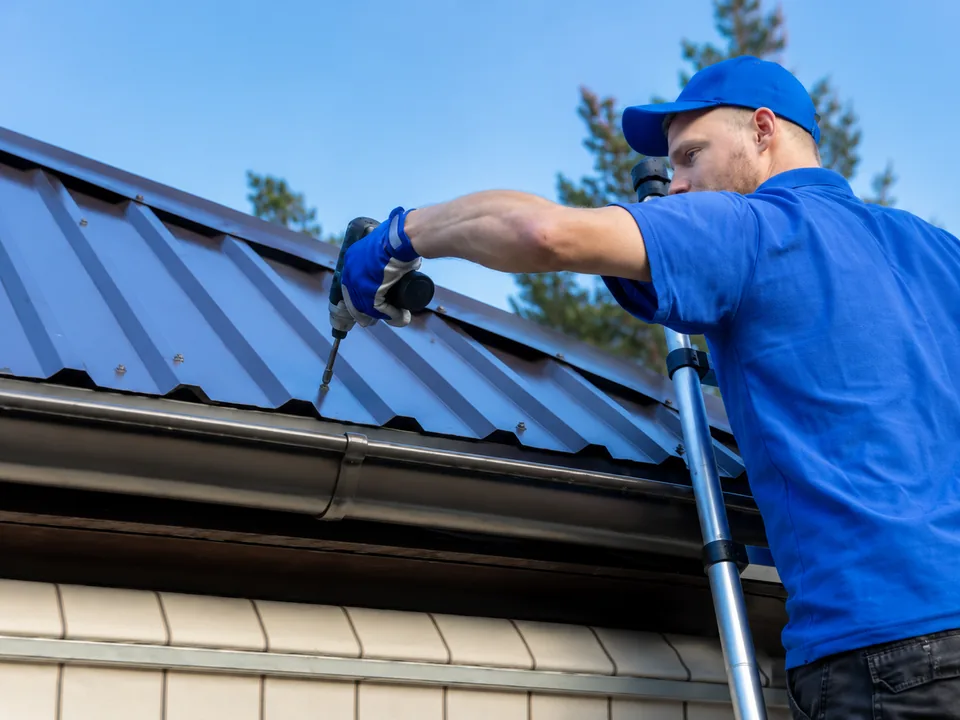 Metal roof repair
We trace the leak to its source before recommending a repair.
The gap between a targeted repair and a full replacement is large, and getting the diagnosis right decides which you need.
A repair only holds if it addresses the source. Sealing over a symptom buys a few months and hides the problem while it carries on.
The Service
Why Metal Roofs Leak Where They Do
A metal panel is a large, continuous surface, and water rarely gets through it. Water gets in where the roof stops being continuous: at a lap, a seam, a screw hole, a valley, or where the roof meets a wall, a pipe, or a chimney.
Thermal movement drives much of it. Metal expands and contracts every day, and the fixings and sealants holding everything together absorb that movement for years. Screws work loose. Neoprene washers flatten and split. Sealant hardens and pulls away from the joint it was meant to bridge. None of that is a defect; it is the system aging, and it is the kind of condition repair work is meant to address.
The practical consequence is that a repair has to be aimed at a specific mechanism. Running fresh sealant across a roof is not a diagnosis, and it tends to trap water rather than shed it.
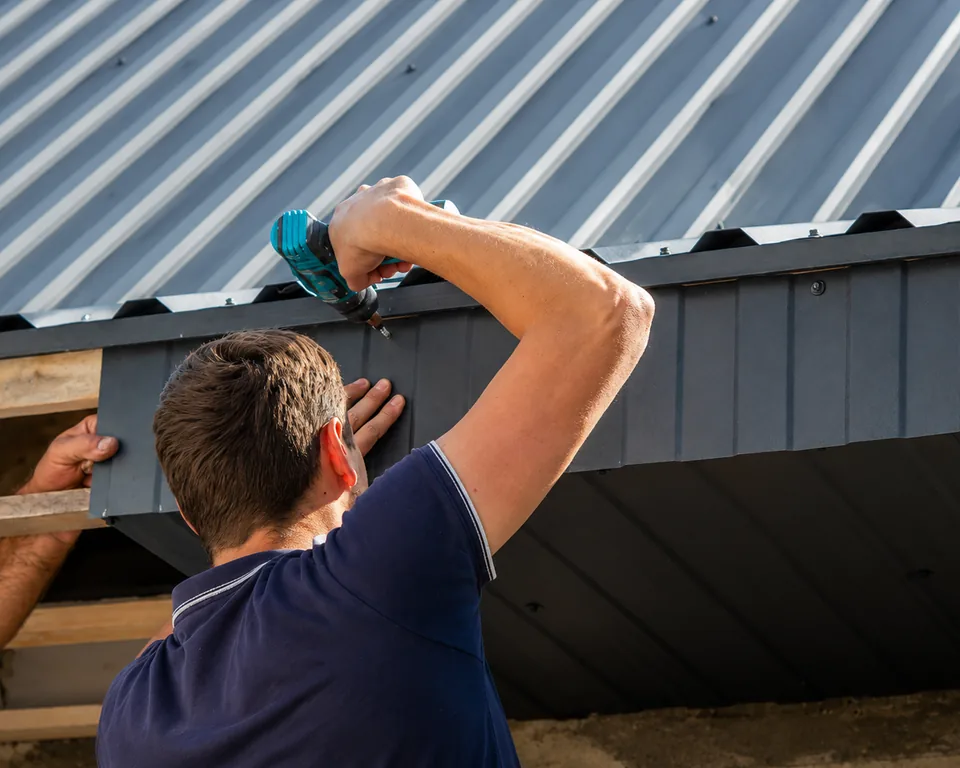 Metal roof repair
When To Act
Signs a Repair Is Worth Booking
A few of these need attention quickly. Most do not, but all of them are worth looking at before the next long spell of rain:
- Water stains on a ceiling or wall that appear after rain and fade in between.
- Screw heads standing proud of the panel, or a fastener line that no longer runs straight.
- Rust streaking below fixings, along panel ends, or at cut edges.
- Sealant at a pipe boot or wall flashing that has hardened, split, or lifted away.
- A panel edge that has lifted, or trim that has worked loose at a corner.
- Daylight visible around a penetration when you are up in the attic.
- Gutters or valleys that pack with debris again shortly after clearing.
- A roof that drums or bangs in wind when it used to be quiet.
Diagnosis
Common Problems and What They Point To
These are common examples of how metal roofs fail, not claims about specific completed jobs. The visible symptom is rarely the whole story.
How a repair is carried out depends on the panel system, and the two common systems need different work.
On an exposed-fastener roof, repairs usually centre on the fixings. Backed-out screws can often be replaced, commonly with a larger-diameter fastener where the original hole has enlarged, along with a fresh washer. That is straightforward when it is confined to a few areas. When the same failure is appearing across the whole roof, replacing every fastener starts to approach the cost of a wider solution, and that is worth saying plainly.
A standing seam roof carries its fixings underneath the panel, so repairs concentrate on seams, clips and flashings instead. There are far fewer holes to fail, but the work is more specialized, because panels are engaged along their full length and reaching a clip can mean carefully opening a seam. Standing seam is repairable. It is simply a different job.
| Visible issue | Possible source | Why evaluation matters |
|---|---|---|
| Stain on a ceiling after rain | A failed flashing joint, a backed-out fastener, or an open seam somewhere upslope | Water travels before it drops, so the stain rarely sits under the entry point. |
| Screws standing proud, or missing | Thermal cycling backing fasteners out, or washers that have flattened and split | Each one is an open hole. Left alone, wind works the panel and enlarges it. |
| Rust streaking below fixings or at cut edges | Coating breached at the fastener or the cut, letting corrosion start there | Surface staining and genuine loss of metal are different conditions, judged separately. |
| Sealant cracked or pulled away at a penetration | UV and movement hardening the sealant past the point where it can still flex | Penetrations are the most worked details on a roof, and the most common repair. |
| A seam that has opened or lifted | Panel movement, a fixing that has stopped doing its job, or wind load at an edge | Seams hold water out by shape. An open seam leaks with nothing visibly broken. |
| Ponding, or debris that never clears | Blocked drainage, a low spot, or debris trapped at a valley or transition | Standing water and trapped debris keep moisture against panels and fixings. |
| A dented panel after hail | Impact. Appearance and functional damage are not automatically the same thing | Denting does not by itself prove a panel has stopped performing, and it does not automatically mean replacement. What decides it is the coating, the seams, the panel itself, and the condition of the roof around it. |
Leak Tracing
Finding Where the Water Gets In
The stain marks where water arrived. The entry point sits somewhere above it, often several feet away, because water runs along the underside of panels and across framing before it finds an edge to drop from. Working straight up from the stain is how the wrong detail gets repaired.
The approach is to work out what sits upslope of the stain and check each candidate in turn: penetrations, seams, laps, fixings, and any transition where the roof changes plane or meets a wall. Attic access makes this considerably more reliable, because the underside records the path the water took.
Not all interior moisture is a leak. Metal is prone to condensation forming underneath the panels when the roof surface cools below the dew point of the air beneath it, which produces damp insulation and drips with nothing wrong outside at all. The National Roofing Contractors Association treats that as a separate problem with a different fix, usually a matter of underlayment and ventilation. A repair aimed at condensation will not work, so it is worth establishing which one you have.
Wind and hail can both produce the conditions in the table above. Where a specific storm is the trigger, storm damage repair covers that side, including how damage is assessed after an event. This page deals with the wear and defects that turn up regardless of weather.
One boundary worth stating plainly: a repair assessment establishes what is wrong with the roof. It does not determine what an insurer will or will not cover.
The Decision
Repair or Replace
Most metal roofs that leak do not need replacing. The question is whether the problem is concentrated or general.
Repair usually makes sense when the fault is confined to specific details: a flashing joint, a run of fasteners in one area, a damaged panel or two, sealant that has reached the end of its life at penetrations. The rest of the roof is doing its job, and there is no reason to disturb it.
Replacement starts to make more sense when the same failure repeats everywhere, when corrosion has moved past surface staining into actual loss of metal, when the deck below has been wet long enough to soften, or when the roof is old enough that repairs only defer the decision by a season or two.
There is a middle path that gets overlooked: some roofs are worth repairing now and replacing later, which spreads the cost and buys time to budget. If that is the honest answer for your roof, it is the one you will get. The metal roof cost guide covers what drives the numbers, and replacement covers what that work involves.
How It Works
Our Process
- Step 1
Review the reported problem
Where the water shows up, when it appears, how long it has been happening, and what the roof has been through recently.
- Step 2
Inspect the area and what surrounds it
The reported spot plus the details above and around it, since the entry point is usually somewhere other than the stain.
- Step 3
Identify the likely source and extent
Whether this is one failed detail or a pattern repeating across the roof, and how far any water has already travelled.
- Step 4
Explain the options
What a repair would involve, what it will not solve, and whether monitoring or a wider conversation about replacement is the more sensible route.
- Step 5
Carry out approved work and review it
Agreed repairs completed, then the repaired area and the details around it checked over before the work is signed off.
Property Type
Homes and Commercial Buildings
On houses, a repair is usually triggered by something visible: a stain, a drip, a screw line that has started to look wrong. Access and pitch shape what can be reached safely, and a steep or fragile roof gets assessed from the safest available position rather than by walking every plane.
Commercial roofs bring different problems forward. Low-slope sections make drainage and ponding a primary concern rather than a secondary one. Larger spans mean more thermal movement working on the same details year after year. There are usually more penetrations, and rooftop units add curbs, conduit and foot traffic that wear the roof around them. Repairs often have to be scheduled around occupancy. Commercial metal roofing covers that side of the work.
Scope
What Affects a Repair
No flat repair price is published here, because a repair is priced by what is actually wrong. What moves the number:
For a full breakdown, see our metal roof cost guide for Conroe, TX, then request a metal roof estimate.
- The source of the problem, and how many separate points need attention.
- Whether flashing can be resealed or has to be replaced.
- Panel system, since exposed-fastener and standing seam repairs are different work.
- Whether panels can be repaired in place or need replacing.
- Roof access, pitch, and safe working requirements.
- Whether the deck under a long-running leak has been affected.
Request Metal Roof Repair in Conroe, TX
Tell Conroe Metal Roof Pros about your roof and we will help you plan the next step.
Keep Exploring
Related Metal Roofing Services
Explore the services that pair with this one, or see the full list.
Service Areas
Conroe Metal Roof Pros serves Conroe and nearby Montgomery County areas.
Answers
FAQs About Metal Roof Repair
What usually causes a metal roof to leak?
Almost always a detail rather than the panel itself: failed sealant at a penetration, a backed-out screw, flashing that has shifted at a wall or chimney, or a seam that has opened. Thermal movement is behind most of it, since the fixings and sealants absorb that daily expansion for years.
Can loose or backed-out screws be replaced?
Yes, and it is common work on exposed-fastener roofs. Where the original hole has enlarged, a larger-diameter fastener with a new washer usually solves it. What matters is whether it is happening in one area or across the whole roof, since a general pattern points elsewhere.
Can standing seam metal roofing be repaired?
Yes, though the work differs. The fixings sit under the panel, so repairs focus on seams, clips and flashings. Reaching a clip can mean carefully opening a seam, which makes it more specialized, but it is entirely repairable.
Can you repair just one section of the roof?
Often, yes. If the fault is isolated and the surrounding roof is sound, a targeted repair is usually right. If the same failure shows up across the roof, we will say so rather than repairing the same thing repeatedly.
Is surface rust a reason to replace the roof?
Not by itself. Rust streaking below fixings or at cut edges is common on older roofs and often stays superficial. What matters is whether the metal has actually lost section, which needs judging up close rather than from the ground.
How do you decide between repair and replacement?
By whether the problem is concentrated or general. Isolated flashing, fastener, sealant and panel faults are repairs. Failures repeating across the roof, corrosion past the surface, or a softened deck point toward replacement. Repairing now and replacing later is a legitimate answer too.