
Metal Roofing Services · Conroe, TX
Commercial Metal Roofing in Conroe, TX
Commercial metal roofs fail in different places than residential ones. A house leaks at its geometry: valleys, dormers, chimneys. A warehouse or retail building usually has simple geometry and leaks at everything mounted on it.
- Warehouse, retail & light commercial
- Large spans & penetrations
- Inspection planning
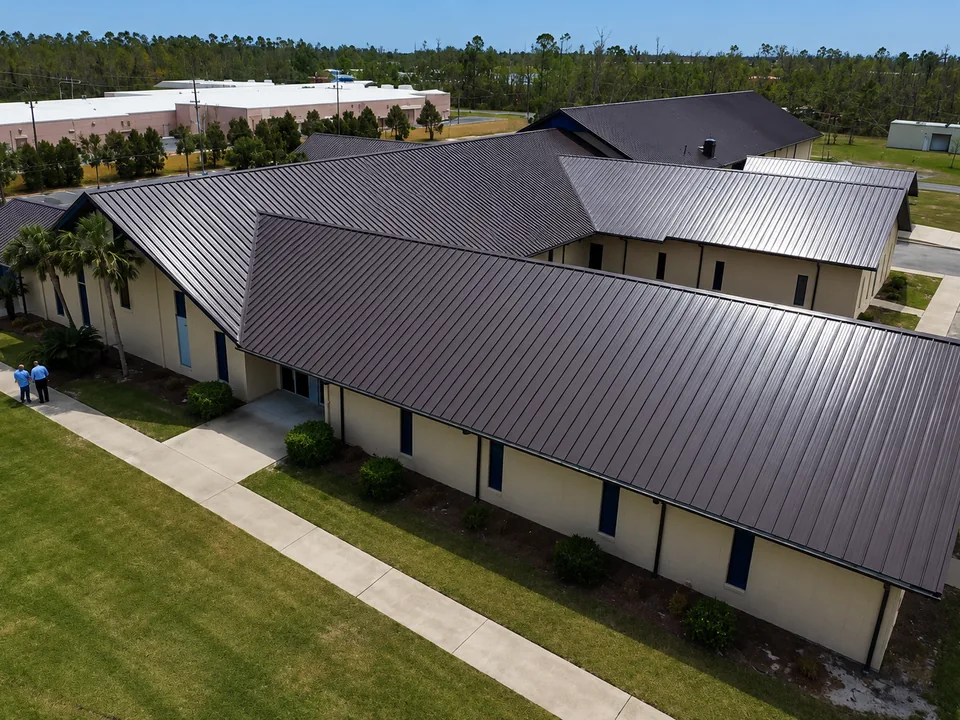 Commercial metal roofing
Planning covers drainage, penetrations, and building use.
That shifts where the attention goes. Long panel runs, wide drainage areas, curbs, vents, conduit and rooftop units are what shape a commercial roof, along with the fact that people are working underneath it while anything gets done.
The roof is also an asset with a service life somebody plans around, which makes the useful conversation less about products and more about condition and what can wait.
The Service
Size, Slope and Where the Water Goes
On a large roof, small slope problems become large ponding problems. Water that would run off a steep house roof unnoticed can sit on a low-slope commercial plane, and standing water finds every marginal detail it touches. Drainage is the first thing worth understanding on a building of any size.
Panel length matters more here too. A long run expands and contracts measurably with temperature, and a system that does not allow for that transfers the load into seams, clips or fixings. On a building with runs measured in tens of feet, that is a planning decision rather than a detail.
The upside is that commercial geometry is usually simpler: fewer valleys, fewer changes of pitch, fewer awkward junctions. What replaces that complexity is everything mounted on the roof, which is where most commercial roof problems live.
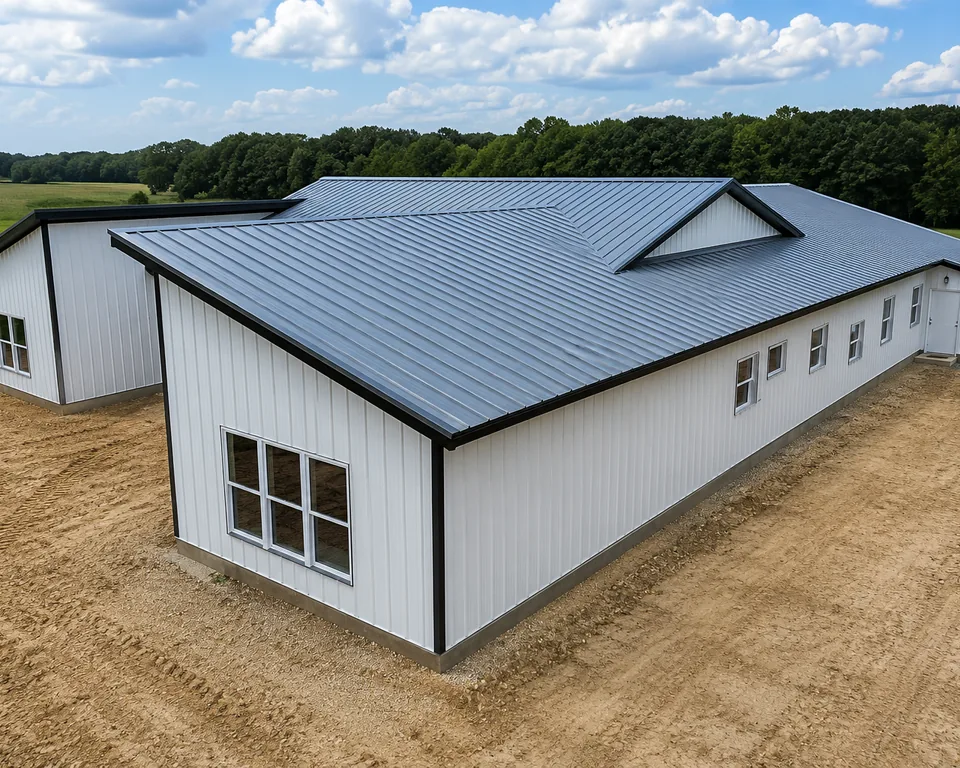 Commercial metal roofing
When To Act
When Building Owners and Managers Get In Touch
The trigger usually shapes which conversation is useful:
- Water is showing up inside and nobody has established where it is entering.
- Ponding is visible after rain, or an outlet is not clearing.
- Rooftop equipment has been added, moved or serviced and the roof around it is now suspect.
- A lease, sale or budget cycle needs the roof’s condition documented.
- Repairs have been carried out repeatedly in the same areas.
- A new building or extension needs a roof specified for how it will be used.
- The roof is old enough that a plan is needed rather than another patch.
Planning
What Usually Needs Clarifying
These are common commercial metal-roofing considerations, not descriptions of specific buildings or completed projects by Conroe Metal Roof Pros.
| Condition or planning issue | Why it matters | What may need clarifying |
|---|---|---|
| Long panel runs | Longer panels move more with temperature, and that movement has to go somewhere | Run lengths, how movement is accommodated, and whether end laps exist. |
| Large drainage areas | On low slope, water that does not leave promptly sits and finds marginal details | Where water is meant to go, and whether it currently gets there after heavy rain. |
| HVAC curbs | A curb interrupts a panel that was designed as a continuous run | How each curb is flashed, and whether any have been altered since installation. |
| Roof-mounted equipment | Units, conduit and supports add penetrations, weight and foot traffic | What is up there, who services it, and whether access routes cross the roof surface. |
| Parapet or wall transitions | Water coming off a wall above the roof has to be intercepted and directed out | How the junction is formed, and whether counter-flashing is present and intact. |
| Existing roof layers | What is already in place affects whether anything can go over it | What coverings exist, and what is known about moisture already in the assembly. |
| Maintenance access | A roof that cannot be reached safely does not get looked at | How the roof is accessed, and whether that route is usable for work as well as inspection. |
| Occupied building | People working underneath shape when and how areas can be worked on | Which areas matter most operationally, and what constraints apply to reaching them. |
Penetrations
Where Commercial Roofs Actually Leak
Commercial roof risk can concentrate around penetrations, curbs, transitions, drainage points and perimeter details, but failure patterns depend on the roof system and building.
Every curb, vent, pipe, conduit support and equipment mount is a hole through an assembly that was designed as a continuous surface. Each one is kept watertight by how it was detailed, and each one has to stay watertight while the panel around it expands and contracts. A rigid detail fixed hard across a moving panel is a detail with a countdown on it.
Equipment servicing adds to it. A unit gets replaced, conduit gets refitted, someone walks a route across the roof monthly. None of that is unreasonable, and all of it works on the roof around the penetration.
Parapets and wall transitions are the other recurring source. Water coming down a wall above the roof plane has to be intercepted by counter-flashing and directed out onto the surface. Where that has been sealed rather than flashed, it tends to work for a while and then not.
Systems
Which System Suits the Building
Both common metal systems appear on commercial buildings, and neither is automatically correct.
Standing seam keeps fixings out of the water path and handles lower slopes and long runs well, which is why it is common on larger buildings. It costs more and the work is more specialized. Exposed-fastener panels cost less and go on faster, and on a workshop, barn or utility building they are frequently the sensible answer. What they bring is a large number of individual sealed fixings, each with a service life shorter than the panels.
The decision follows the building rather than a preference: slope, run length, how much equipment sits on the roof, how accessible it is for maintenance, and how long the owner intends to hold the asset.
Pathways
Repair, Monitor, Partial Work or Replacement
Commercial roofs offer a middle ground that residential ones often do not, because the roof is large enough to treat in parts.
Where a problem is confined to specific details, metal roof repair covers it, and one leak does not mean the roof is finished. Where nobody has established the condition, a roof inspection settles that before anyone quotes work, which also matters when a lease or sale needs documentation.
Where problems are spread across the roof, metal roof replacement covers that decision, including whether an existing covering comes off and what may be found beneath it. On a commercial building, deck condition under a long-running leak is often less visible than on a house, so it is worth planning for rather than assuming.
Monitoring and working in stages are both legitimate answers on a large roof. What is not legitimate is a promise about timing or disruption nobody has worked out with you yet. Any of these routes needs the building looked at first, and what drives the numbers sits on the metal roof cost guide.
How It Works
Our Process
- Step 1
Review the building and what has been reported
How the building is used, the roof layout, access arrangements, what equipment sits up there, drainage, and the concerns that prompted the call.
- Step 2
Examine what can be reached safely
Accessible roof areas, penetrations, curbs, transitions, edges, drainage paths and the visible condition of the system.
- Step 3
Set out the options
What repair, monitoring, partial work or replacement would each involve, what each would not resolve, and what remains unknown until something is opened up.
- Step 4
Confirm the details and the sequence
System details, the order work would follow, which roof areas are affected, and what access is needed to reach them.
- Step 5
Review the completed work
Seams, fasteners, flashing, penetrations, drainage paths, edges and visible finish on the areas worked on.
Planning
Where Commercial Roof Plans Usually Go Wrong
A few patterns recur across building types.
- Treating a leak as a roof problem when it is an equipment-penetration problem that keeps being re-sealed.
- Deferring drainage issues because nothing is leaking yet, until standing water finds a marginal detail.
- Allowing equipment work to happen on the roof without anyone checking what it did to the surface around it.
- Assuming a large roof can be covered over without establishing what moisture is already in the assembly.
- Budgeting from the worst area of the roof rather than from its overall condition.
Building Types
Warehouses, Retail, Offices and Mixed Use
Warehouses and distribution buildings bring the largest spans and longest runs, which puts movement and drainage at the front. Retail buildings carry more rooftop plant per square foot and more parapet detailing. Offices sit between, usually with more units and more interior finish at risk from a leak.
Workshops and light-industrial buildings often have simpler roofs and different priorities, and mixed-use properties can have several of these conditions on one structure. For residential portions of a mixed-use property, residential metal roofing covers the different set of considerations.
Scope
What Affects Commercial Work
No flat price is published here, because a commercial roof is priced by what is on it and how it is reached. What changes the scope:
For a full breakdown, see our metal roof cost guide for Conroe, TX, then request a metal roof estimate.
- Roof area, and how many separate planes and slopes it has.
- Panel system and run lengths.
- Number of penetrations, curbs and units to detail around.
- Drainage work, where outlets or falls need attention.
- Whether an existing covering is removed, and what the deck needs.
- Access arrangements and working around an occupied building.
Request Commercial Metal Roofing in Conroe, TX
Tell Conroe Metal Roof Pros about your roof and we will help you plan the next step.
Keep Exploring
Related Metal Roofing Services
Explore the services that pair with this one, or see the full list.
Service Areas
Conroe Metal Roof Pros serves Conroe and nearby Montgomery County areas.
Answers
FAQs About Commercial Metal Roofing
Which commercial buildings suit a metal roof?
Most of them, though for different reasons. Warehouses and distribution buildings suit it for the spans and long runs. Retail and office buildings often suit it for low-slope performance and the way it handles rooftop plant. Workshops and light-industrial buildings frequently suit a simpler exposed-fastener system. The system choice follows the building rather than the category.
How do rooftop units and curbs affect a metal roof?
They are the most worked details on the roof. Each curb or mount interrupts a panel designed as a continuous run, and it has to stay watertight while that panel expands and contracts. Servicing adds to it, because equipment gets replaced and conduit gets refitted. The areas around rooftop plant are worth looking at specifically rather than assuming they match the rest of the roof.
How is drainage handled on a large roof area?
By establishing where water is meant to go and whether it actually gets there after heavy rain. On low slope, water that does not leave promptly sits, and standing water finds every marginal detail it touches. Blocked outlets, debris at transitions and low spots are the usual culprits, and they are worth resolving before they become a leak rather than after.
Can a commercial metal roof be repaired in sections rather than replaced?
Often, and a large roof is more suited to that than a house is. Where problems are confined to specific details or specific areas, targeted work is usually the right answer. Replacement enters the conversation when the same failure repeats across the roof rather than clustering in a few places.
Why do commercial metal roofs leak at penetrations rather than in the field?
Because the field of the roof is a continuous surface and the penetrations are holes through it. Panels shed water reliably across an open plane. Every curb, vent, pipe and support is kept watertight by how it was detailed, and each one has to keep working while the panel around it moves. That is where the wear concentrates.
What information helps when a property manager gets in touch?
Where water is appearing inside and when it started, what is mounted on the roof, how it is accessed, whether anything has been serviced or added up there recently, and what has already been repaired. Photographs from a safe vantage point help, and any timing constraints are worth mentioning early.