
Cost Factors
Metal Roof Cost in Conroe, TX
What a metal roof involves depends on the roof itself. This page explains what changes the scope of the work, so you can see where the variables sit before you talk to anyone about your property.
- Size, shape & slope
- Deck & existing roof
- Panel system & details
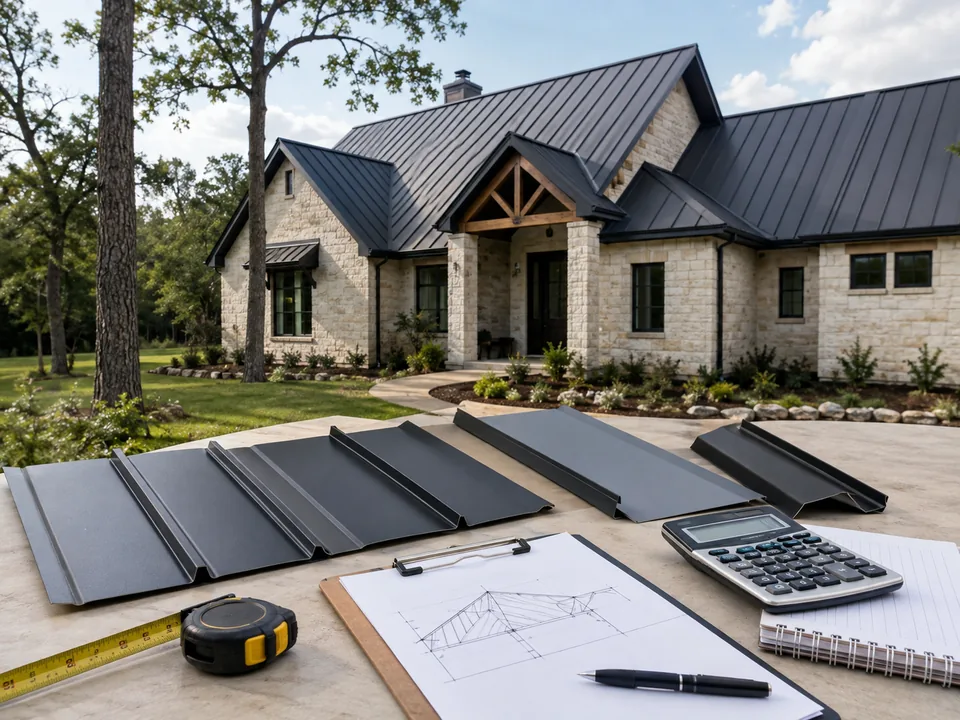 Metal roof cost factors in Conroe, TX
Roof area is a starting point, not an answer. What sits under and around the panels usually decides the work.
Online price ranges can help with early planning, but they vary widely because roof geometry, deck condition, tear-off, panel system and detailing can materially change installed cost. Roof area is the one number a website can get without seeing anything, which is why it makes a poor answer on its own.
Metal Roofing Cost in Conroe, TX
Metal roofing prices are a set of decisions rather than a single figure. Roof area and geometry set how much panel, trim and detailing the building needs. Slope affects both which systems suit the roof and how the work has to be carried out safely. Whether an existing covering comes off, and what the deck underneath turns out to need, sit inside the job rather than beside it. The panel system, the flashing at every penetration and transition, and how material reaches the roof each carry their own labor. Together those are the scope, and the cost follows from it.
The rest of this page works through those variables in order: the factors that move the work most, how installation, replacement and repair differ from one another, what the choice of panel system changes, and what to have ready so a first conversation can be specific about your building.
Is There a Metal Roofing Price List for Conroe?
A price list is genuinely useful for comparing materials. Panel profiles, gauges and finishes are products, and products can be set side by side. What a list cannot usually represent is a complete installed roof, because roof size, geometry, tear-off, deck condition, panel system and detailing change the scope from one building to the next. The same material can go onto two houses on the same street and involve different work.
That is not a reason to keep figures quiet, and it does not mean a roof can never be discussed before anyone has seen it. It means a figure carries more information when it is attached to a described scope. Asking what a number includes — removal, deck repair, underlayment, flashing, trim and accessories — usually tells you more than asking for the number on its own.
Starting Point
Why Roof Area Alone Does Not Settle the Number
Two buildings in Montgomery County can have the same roof area and need noticeably different work. One is a straightforward gable with long uninterrupted panel runs. The other spreads that same area across dormers, a valley or two, a chimney, and a lower section that ties into a wall. The second roof has more edges, and edges are where the labor concentrates.
Slope matters too. A steeper roof takes longer to work on safely, and a very low slope changes which panel systems suit it at all. Then there is what nobody can see from the street: the condition of the deck, and how the previous roof was detailed.
None of this means a price is unknowable. It means the honest order is to establish the scope first and the number second.
Scope Drivers
What Changes the Scope of Metal Roof Work
The factors that move the work up or down most often, and what usually needs clarifying about each.
| Cost factor | Why it changes the scope | What may need clarification |
|---|---|---|
| Roof size | Sets how much panel, underlayment, and trim the roof needs, and the time spent on open field area. | Approximate area, and whether outbuildings are included. |
| Roof geometry | Valleys, hips, dormers, and changes of plane add cutting, fitting, and flashing that flat field area does not. | General shape, number of roof levels, and roughly how steep it is. |
| Existing roof covering | Decides whether it comes off, what removal involves, and what condition it leaves behind. | Current material, roughly how old it is, and how many layers. |
| Deck condition | Panels need a sound, even surface. Soft or damaged decking has to be corrected before anything goes over it. | Known leaks, ceiling staining, or areas that feel soft underfoot. |
| Metal roof system | Standing seam and exposed-fastener panels are installed differently and call for different detailing and labor. | Which system interests you, and whether appearance or maintenance matters more. |
| Valleys and transitions | Water concentrates where planes meet and where the roof runs into a wall, so these carry more work per foot. | Where the roof meets walls, chimneys, or a lower section. |
| Penetrations and equipment | Every vent, pipe, curb, or rooftop unit interrupts the panel run and has to be flashed on its own terms. | Number and type of penetrations, and any rooftop equipment. |
| Access and material handling | Metal panels are long and awkward. How close a vehicle can get, and how material reaches the roof, changes the time involved. | Driveway and yard access, overhead lines, and building height. |
| Coating, color, trim, and accessories | Finish, trim profiles, and edge and ridge details are part of the system rather than extras added at the end. | Color and finish preference, and any accessories considered. |
These are common factors that affect the scope of metal roof work, not prices, and not descriptions of specific projects completed by Conroe Metal Roof Pros. Which of them apply depends on the building.
Pathways
Installation, Replacement, and Repair Are Different Work
The first thing that shapes a budget is which kind of project this is. These are not variations on one job.
New installation
New construction, an addition, or a first metal roof on a detached building. There is no old covering to deal with and the deck is typically known, so decisions about panel system, layout, and detailing get made before materials are ordered. Metal roof installation covers that work.
Replacement
An existing roof comes off, or in some cases a new roof goes over it. That decision, what the deck looks like once exposed, and how much of the old flashing has to be reworked all sit inside the scope. Metal roof replacement covers it.
Repair
Scope depends on whether the source is isolated or spread across the roof. One leak does not automatically mean the roof needs replacing, and sealant spread over a symptom is not a substitute for finding the cause. Metal roof repair covers how a source gets traced, and storm damage is handled separately because weather events raise their own questions.
Not sure which applies
A normal starting position. A metal roof inspection exists to work out which pathway a roof is on before anyone commits.
Panel Systems
Standing Seam and Exposed Fastener Are Not the Same Job
Exposed-fastener panels are screwed through the face into the structure below. The approach is direct, and the fasteners are visible and reachable. Standing seam metal roofing works differently: concealed clips hold the panels, seams are formed along raised ribs, and the assembly is designed to move as temperatures change. Layout, seam work, and trim detailing are more specialized as a result.
The practical consequence is that the two systems carry different labor even on the same roof, and the difference is not a fixed relationship you can apply to any project. A material price compared in isolation will mislead you, because it leaves out the installation that goes with it.
Underneath
What the Existing Roof May Be Hiding
On a replacement, the deck is the part of the scope nobody can fully confirm in advance. Water traveling through a fastener hole or an old flashing joint can leave the covering looking unremarkable while the boards underneath have gone soft. Ceiling stains, a spongy feel underfoot, or daylight in the attic all point at it, but the complete picture only appears once the covering is off.
Deck condition, old underlayment, and previous repairs are variables to be checked and accounted for in advance, not surprises to be sprung halfway through.
Materials
Materials, Coatings, Trim, and the Parts Around the Panels
Panels get the attention, but a metal roof is an assembly. Underlayment, ridge and edge trim, valley metal, closures, flashing, and the fasteners themselves all belong to the system. Substituting a cheaper component usually shifts the consequence somewhere else rather than removing it.
Coating and color sit in the same category. Finish affects appearance and how the panel weathers, and trim profiles have to match what the panels do at the edges. These are choices worth making deliberately rather than leaving as a last-minute line item.
Property Type
Houses and Commercial Buildings Are Scoped Differently
On a house, complexity usually comes from shape. Dormers, chimneys, skylights, and multiple roof planes create detail work, and appearance carries weight because the roof is visible from the street. Residential metal roofing covers those decisions.
On a commercial building the drivers shift. Roof areas are larger and flatter, drainage has to move more water across longer distances, and rooftop equipment brings curbs and penetrations that each need detailing. Access, staging, and working around an operating business become part of the planning. Commercial metal roofing covers that side, and the full list of services shows where each pathway leads.
Useful Detail
What Helps Clarify the Scope
None of this produces a number by itself. It does make the first conversation specific.
- Property type: house, commercial building, or detached structure
- Approximate roof area, if you happen to know it
- How many roof levels there are, and the general shape
- Roughly how steep the roof is
- What is on the roof now, and approximately how old it is
- Any known leaks, ceiling staining, or damp inside the building
- Visible damage, loose panels, or missing trim
- Chimneys, skylights, vents, or rooftop equipment
- Whether standing seam or exposed-fastener panels interest you
- Whether this is installation, replacement, repair, or still undecided
Clear photographs taken from ground level are useful, and there is no need to get on the roof to take them. If something is only visible from up there, that is a reason to have it looked at properly rather than a reason to climb.
What to Expect
What a Straight Cost Conversation Covers
Whoever you end up speaking to, a cost discussion is more useful when it accounts for the specifics rather than the averages. That means naming the panel system and finish, being clear about whether the old covering is coming off, and being explicit about anything that cannot be confirmed until work starts.
Two numbers for the same roof often differ because they describe different work. Comparing them fairly means comparing what is included, not just the total at the bottom.
Conroe Metal Roof Pros works across Conroe and Montgomery County, including The Woodlands and Montgomery. The general FAQs cover broader questions about metal roofing in Texas.
Answers
Metal Roof Cost FAQs
How much does metal roofing cost in Conroe, TX?
It depends on the roof rather than on the area it sits in. Roof size and geometry, slope, whether an existing covering is torn off, what the deck turns out to need, the panel system, the amount of flashing and detail work, and how easily material reaches the roof all change the scope — and the scope is what a figure is built from. Describing those things for your own roof is what turns a general estimate into a number worth relying on.
Can I get a metal roofing price list before requesting an estimate?
Material pricing and installed pricing are different things. A list can compare panel profiles, gauges and finishes sensibly, because those are products. A complete installed roof also includes removal where it applies, deck work, underlayment, flashing, trim and the labor each of those takes, and that combination changes from one building to the next. Asking what a figure includes is usually more informative than asking for a list.
Why can a metal roof not be priced from square footage alone?
Area tells you roughly how much panel a roof needs and very little else. Two roofs of the same size can carry different amounts of valley and edge work, sit at different slopes, and rest on decks in different condition. Labor follows the details rather than the area, which is why a figure produced from square footage alone rarely survives contact with the actual roof.
Does standing seam involve a different scope than exposed-fastener roofing?
Usually yes. Standing seam panels are held by concealed clips and joined along raised seams, so panel layout, seam work, and allowance for thermal movement have to be planned in advance. Exposed-fastener panels fasten through the face and go on more directly. The work differs in kind rather than only in degree, so the two systems seldom involve the same labor even on an identical roof.
Does replacing an existing roof involve more work than a new installation?
Often, because replacement starts with something already in place. The existing covering may need to come off, the deck underneath stays unknown until it is exposed, and old flashing usually has to be reworked rather than reused. A new installation starts from a known deck, so most of the planning happens before materials are ordered.
Why can hidden deck conditions not be settled in advance?
Because they sit underneath the roof covering. Moisture that has moved through a fastener hole or an aging flashing joint can leave the surface looking ordinary while the deck below has softened. The full picture appears when the covering comes off, so treating deck condition as a question still to answer is more honest than treating it as a line already known.
Why do two roofs of the same size need different amounts of work?
Shape. A simple gable roof is mostly open field area, where panels run long and uninterrupted. Add dormers, valleys, chimneys, skylights, or rooftop equipment and the same area gains edges and transitions that each have to be measured, cut, and sealed individually. Detail work takes disproportionately longer than field area.
What details help clarify the scope of a metal roof project?
Property type, roughly how large the roof is if you know, its general shape and slope, what is on it now, whether there are known leaks or visible damage, and anything sitting on the roof such as chimneys, skylights, or equipment. It also helps to say if you have installation, replacement, or repair in mind, or are not yet sure. Clear photos taken from the ground are useful.
Talk through what your roof actually involves
Tell Conroe Metal Roof Pros what you have, and we will help you work out what the project involves.
Keep Exploring